
We are pleased to announce that the work entitled “A Framework for the Analysis of the Coupled Aerodynamic-Dynamic Response of a Vehicle: An OpenFOAM Approach” will be presented on July 2, 2026, by Alice Zanella at the 21st OpenFOAM Workshop, taking place in Porto, Portugal.
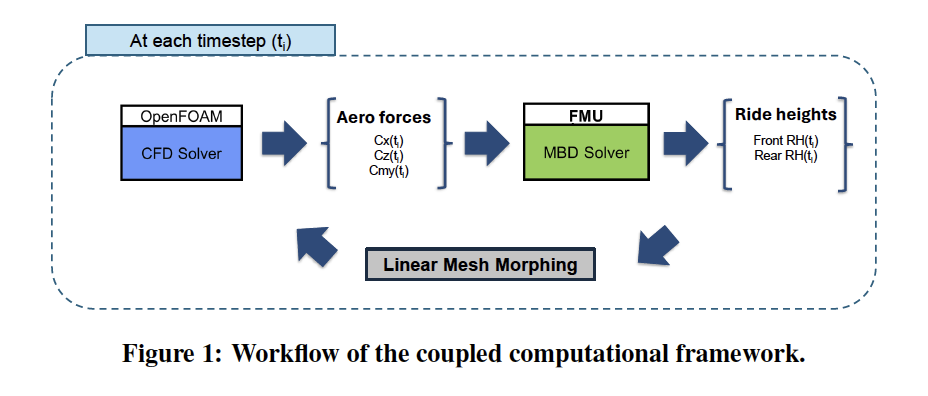
The contribution presents a computational framework for the coupled simulation of vehicle aerodynamics and vehicle dynamics, addressing complex transient phenomena driven by the interaction between aerodynamic loads and suspension response. The framework combines OpenFOAM for Computational Fluid Dynamics with a vehicle dynamics model exported as a Functional Mock-up Unit (FMU), while the partitioned coupling between the two solvers is managed through preCICE. This modular architecture enables the investigation of strongly coupled fluid–structure interactions relevant to modern ground-effect vehicles.
A key aspect of the proposed methodology is the mesh deformation strategy. Large vehicle motions close to the ground pose significant challenges for conventional mesh morphing techniques, often compromising mesh quality and numerical robustness. To overcome these limitations, the framework employs RBF Morph, the mesh morphing technology developed by rbfCAE.
The methodology leverages Radial Basis Function interpolation during a preprocessing stage to compute the maximum prescribed mesh deformation. During the transient simulation, the computational mesh is efficiently updated through linear superposition of precomputed deformation modes, enabling robust handling of large-amplitude vehicle motions while preserving mesh quality and computational efficiency.
The preliminary validation, performed on the Windsor body benchmark, demonstrates the capability of the framework to reproduce the coupled aerodynamic–dynamic response associated with ride-height variations. The results show the onset of oscillatory behaviour arising from the interaction between aerodynamic forces and the suspension system, providing a solid foundation for future investigations of more complex automotive configurations and unsteady aerodynamic phenomena.
The presentation highlights how advanced mesh morphing technologies can effectively support high-fidelity multiphysics simulations, extending the applicability of open-source CFD tools to challenging industrial problems involving moving boundaries and strongly coupled physics.
Here is the document.