
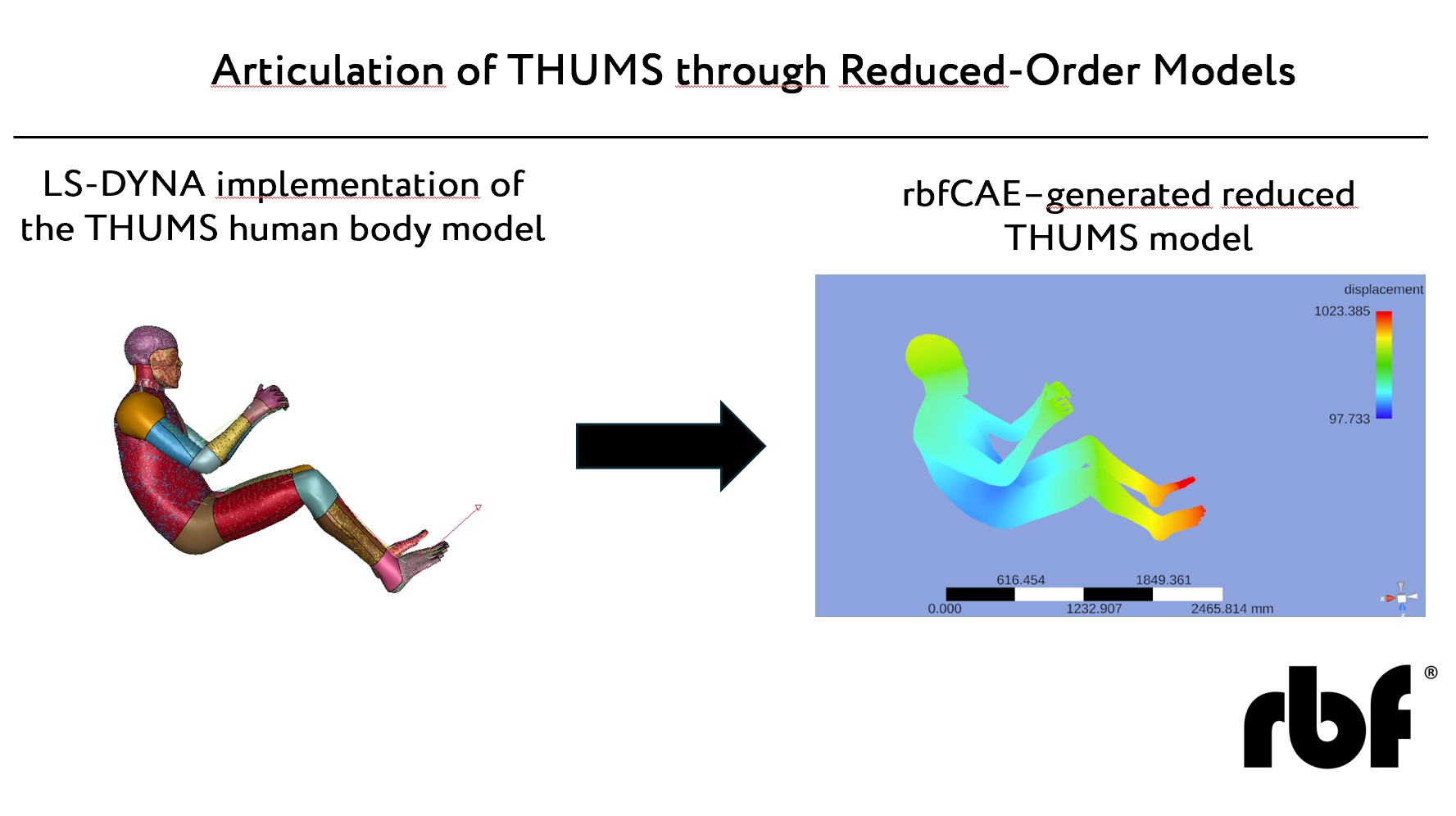
We are pleased to highlight a new Master’s thesis developed at the University of Rome Tor Vergata that showcases the application of the rbfCAE platform to advanced biomechanics and reduced-order modeling.
Entitled “Articulation of THUMS through Reduced-Order Models,” the thesis was carried out by Samuele Stazi under the supervision of Prof. Marco Evangelos Biancolini and co-supervision of Emanuele Di Meo.
The research investigates an efficient methodology for articulating the THUMS (Total Human Model for Safety) digital human model by combining reduced-order modeling techniques with the mesh morphing capabilities of the rbfCAE platform. The proposed workflow enables realistic joint articulation while preserving mesh quality, eliminating the need for repeated and computationally expensive remeshing operations.
Within the developed framework, rbfCAE is employed to perform smooth and accurate mesh deformation, supporting the generation of articulated human body configurations suitable for crashworthiness and occupant safety simulations. The integration with reduced-order models further enhances computational efficiency, making the approach well suited for parametric studies, virtual prototyping, and AI-driven engineering workflows.
This work demonstrates how the flexibility of the rbfCAE platform extends beyond traditional industrial shape optimization, enabling advanced applications in biomechanics and human body modeling. By bridging mesh morphing and reduced-order techniques, the thesis contributes to the development of faster and more scalable simulation workflows for safety engineering.
You can read the presentation and the full thesis.